AI Principles for Audiovisual Media Services

Download the document
Brussels, 16 June 2026. AI offers significant opportunities for the audiovisual sector. Sustainable innovation depends on rightsholders retaining exclusive control on the use of their works. Value creation must be anchored in market driven approaches that meet appropriate standards of transparency, contractual freedom, and technology neutrality. These conditions are needed for viable licensing markets and policies that deliver legal certainty.
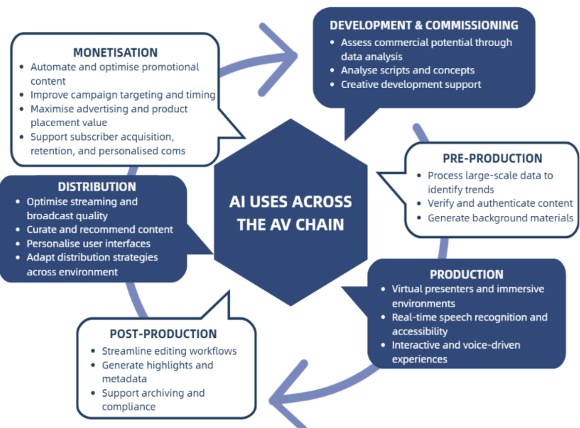
Audiovisual Media Services (AVMS) interact with AI in three manners, each calling for a different approach but anchored in the same principles: transparency, responsibility and control over content.
- Meaningful transparency to uphold rights. When third parties’ use AVMS’ content, copyright rules and transparency rules must apply fully and effectively, so rightsholders can authorise or refuse the use of their works.
- Editorial control over use of AI. When AVMS use AI themselves, existing editorial responsibility frameworks apply. Regulation must therefore remain proportionate and respect editorial control and independence.
- Fair, voluntary, and direct licensing. When content is licensed, it must be voluntary, direct and under full rightsholder control, enabled by transparency.
PART I. MEANINGFUL AND EFFECTIVE TRANSPARENCY TO UPHOLD RIGHTS
The EU’s copyright and AI framework—particularly the CDSM Directive and the AI Act—sets out rules governing the use of protected works for AI training. Significant uncertainties around implementation remain, but the framework is robust enough to adapt to technological changes and provides a solid basis for assessing infringements at both the input and output stages of AI systems.
The AI Act requires general‑purpose AI (GenAI) providers to ensure transparency about the copyrighted materials used in training, which is an essential first step. But transparency is only effective where it gives rightsholders the detail needed to effectively enforce their rights. This means access—tiered as appropriate—to the information needed to assess compliance and engage in licensing negotiation: URLs, public/restricted access status, crawling protocols, opt-out signal recognition, and copyright risk assessment methods.
Transparency and copyright are closely interlinked. Without meaningful, granular transparency, rightsholders cannot effectively identify uses of their works or take action. The priority should now be the effective implementation and enforcement of the newly adopted AI Act, ensuring that it supports the proper application of the existing EU copyright acquis.
PART II. AVOID ONE SIZE FITS ALL APPROACHES – THE IMPORTANCE OF EDITORIAL CONTROL
AVMS operate under strict national rules and frameworks requiring them to handle information responsibly and ethically. Independence, integrity, and high standards are upheld through a combination of internal policies, journalistic codes, constitutional and legal frameworks, and regulatory oversight. At EU level, this is reinforced by the European Media Freedom Act (EMFA), and the Audiovisual Media Services (AVMS) Directive, which together establish a framework for editorial control and responsibility.
A cornerstone of this system is that AVMS bear full liability for their content and services, whether or not AI was used. All AI uses by AVMS – whether GenAI in creation to recommender systems in distribution – fall within editorial responsibility and control. They integral to editorial processes and an expression of editorial choices. External interferences with them represent an interference with editorial independence.
AVMS stand behind their use of AI and accept accountability for it. Unregulated actors such as GenAI companies and very large online platforms do not: they create, disseminate and profit from AI while refusing responsibility. This distinction must be central to AI regulation. Restrictions on AI use by AVMS must be proportionate and account for the interferences with editorial and artistic freedom they entail. This matters most where policymakers consider blanket measures, such as mandatory labelling of GenAI content (eg. Art. 50 AI act) or the regulation of recommender systems (eg. possible Digital Fairness Act). Editorial control must be explicitly recognised and preserved in any such framework.
PART III. FAIR, VOLUNTARY AND DIRECT LICENSING WITH FULL RIGHTSHOLDER CONTROL
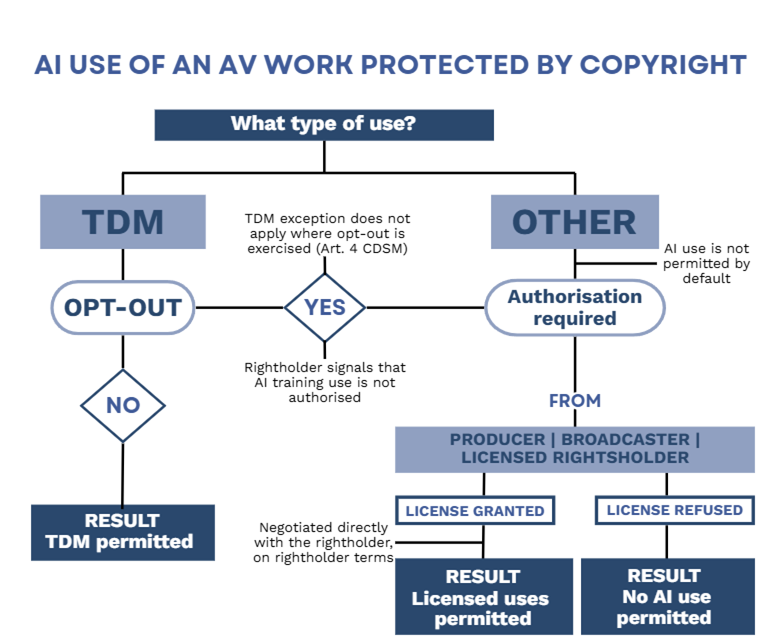
The AV sector depends on exclusive exploitation rights, in practice consolidated in the hands of producers and broadcasters (who are legally and financially responsible for the work). Direct and voluntary licensing is therefore the appropriate basis for any use of AV works in AI training, fine‑tuning, or model development. The entity controlling the rights can license them directly, maintaining legal certainty and protecting investments.
Collective management – mandatory or extended – does not fit the AV licensing practice. The AV-industry relies on exclusivity, high production investments and precise control over how works are used. CMOs in the AV sector are neither entitled nor positioned to manage exploitation licenses for specific works, whether for AI or any other commercial use. Collective licensing cannot accommodate the complexity of AV rights, the diversity of contributors, or the need for rights to tie rights to commercial value, exclusivity and distribution strategy.
Rightsholders must retain full control over whether their content can be ingested by AI systems. This includes the right to authorise or refuse use through voluntary licensing, the ability to exercise opt‑outs under Art. 4 of the CDSM Directive, and the capacity to negotiate terms reflecting the specific value and risk profile of the content used.